Why a Wedding Checklist Is Not Enough
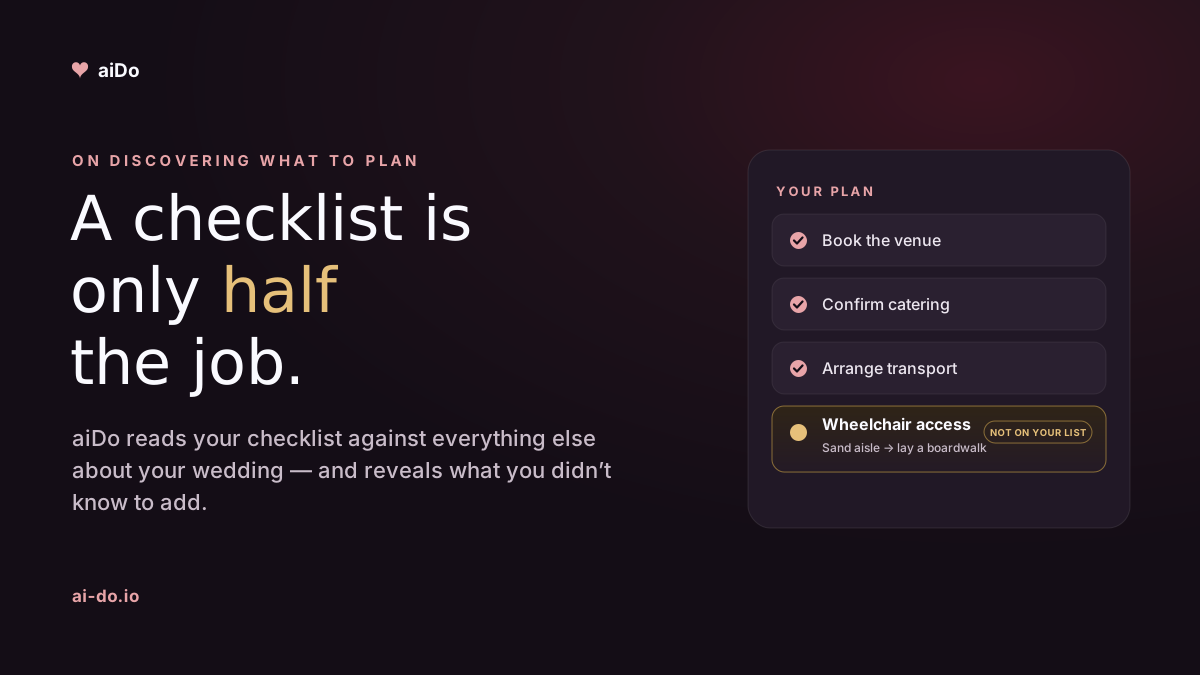
A wedding planning checklist can remember the common path. The hard part is discovering the work created by your particular guests, events, venue, culture, and constraints.
You've seen the list. The "12-Month Wedding Checklist." It's the same 150 boxes for every couple on earth, and ticking every one of them gives you a genuine feeling of progress. Just not the feeling that your wedding is actually handled.
I know this because I tried to build one.
I'm a software developer, and a couple of years ago I set out to build a wedding planning app for my own wedding. Ours was a complicated one: a four-event Hindu wedding in Mauritius, my wife's home country, with hundreds of guests and relatives travelling internationally. The obvious first move was a checklist, so I built a big, thorough one. Ninety-two items, covering every standard piece of a wedding I could think of.
That checklist had one specific flaw, and it took me a month to understand it. It's the same wall every couple and planner runs into, usually without ever being able to name it.
A checklist tells you what weddings usually need
It's a little strange when you stop to think about it. A wedding is one of the most personal, specific events a person ever plans: your families, your cultures, your people, your place, none of it quite like anyone else's. And to pull it off, we all reach for the same checklist everyone else gets.
A checklist is genuinely useful. It gives you structure and reminds you of the common things: book the venue, choose the caterer, send invitations, confirm the timeline. But look at what it's actually good at: it tells you what weddings need, the average of everyone's. What it can't tell you is what your wedding needs.
And that's the real challenge. It was never remembering to book a venue. It's discovering everything your wedding depends on.
For a couple, that might mean realizing you need transportation before guests start booking hotels. For a planner, it might mean catching that dependency before your client even knows to ask about it.
That's where a static checklist starts to feel thin. It can only ask the questions someone predicted in advance. That's fine for the obvious stuff. Yes, you need a venue, thank you, I was aware. But the obvious stuff was never the part that was going to blow up.
The part that blows up is the stuff you didn't know to worry about yet. It almost always starts with an ordinary checklist item colliding with one fact about your wedding.
Take a single line off the list: confirm catering. By itself, it's a checkbox. But hold it next to one detail about your day (you're serving four separate events), and that checkbox quietly splits: a headcount for each event, a kids' count, a dietary count per meal, and a date the caterer needs them all by. None of that was on the list. Your specific wedding is what put it there.
That's the move a checklist can't make. It gives you the common path, but the hard part of planning lives in the items that only exist because this wedding is this wedding: an ordinary task crossed with a specific fact, becoming a to-do no template could have printed.
You can't put a thing on your to-do list before you've realized it's a thing. That's the whole trap. A checklist gives you closure, but discovery is the part you actually needed help with.
Here's the whole idea in one picture. Flip it from the checklist to aiDo:
How planning actually works
The checklist looked done.
Left, the pieces in play. Right, the checklist. On the Checklist tab the two pieces sit far apart and never touch. Flip to aiDo and it pulls them together into something new.
What planning actually is
A checklist records work after somebody has discovered it. Planning is the conversation that finds the wedding-specific work in the first place.
Say “beach ceremony,” and a careful planner asks whether the aisle is sand, whether a relative uses a wheelchair, and whether a temporary path is needed. The point is not to replace the checklist. It is to find the work that belongs on it, give that work an owner, and define what “handled” means.
Before you tick off an important item, ask three questions
- What fact about our wedding changes this standard task? Put the item beside the real event list, guest needs, venue rules, cultural requirements, contracts, and travel plans.
- What must happen first, and what else depends on it? A hotel decision may create transport work. A ceremony time may change supplier arrivals, photographs, childcare, and every guest itinerary.
- Who owns the newly discovered work, and what would “handled” mean? Give the next move to one person and define the evidence that proves it is complete.
Those questions do not make a checklist less useful. They make it honest. The box remains a reminder, while the wedding-specific work around it becomes visible.
Keep the checklist. Just do not mistake it for the plan.
Keep the checklist. It is useful scaffolding and memory support. Just do not mistake the printed boxes for the whole wedding.
Before checking off an important item, hold it next to the facts of your wedding. Ask what those facts change, what has to happen first, and what new work they create. That is where planning begins.
AI can help with that discovery work—but only if you give it the real wedding context and keep its answers organized. Read the practical guide to planning a wedding with AI for the complete method, including the wedding brief, ChatGPT Project setup, working plan, and wedding-day handover.
I'm Jon. I built aiDo after using it to plan my own four-event wedding in Mauritius; the largest event had 400 guests. It is an AI wedding-planning concierge for couples, the family members helping them, and the planners who bring the whole thing together.